Exhibits 7 - 9
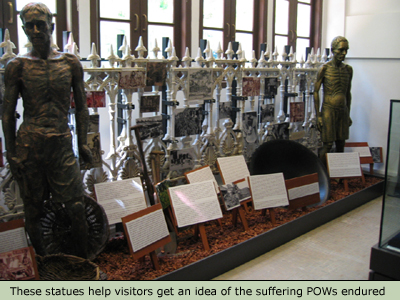
Initially, the POW camps were differentiated by nationalities, but the POWs were mixed when they moved to Changi Prison. Camps were basically open spaces with barbed wire left by the British strung around the encampment to deter escapes. Guards were stationed at strategic points in the camps. There were also petrols around the fencing. The guards were mainly INA (Indian National Army) recruits, Koreans or Taiwanese. Accommodations in the internment camps were filthy. The POWs faced problems like food shortages and isolation, but they did their best to counter these problems by growing their own food and organising activities that helped to maintain their morale. Some POWs were forced to work as labourers for the Japanese, clearing up the debris in various parts of Singapore and building the Shinto Shrine at MacRichie Reservoir. Others were sent to work on the "Death Railway", where many POWs died due to disease and lack of medical attention. However, not all civilian POWs were interned. Those who held positions of responsibility in essential services, such as enginners in the water and electricity department, were allowed to continue their work wearing "Civilian Enemy" armbands.
This was a trying time for the POWs as they suffered from the indignity of surrender to the Japanese and humiliation as prisoners. Yet, they held their heads high and organised themselves in the camps in order to better their chances of survival and maintain morale. Improvising to the harsh conditions there, they made use of all available material to better their living conditions. Some drew or recorded this period of their lives in diaries in order to preserve their humanity and keep themselves busy during their leisure time in the deporing condtions of the camps. All these marked their resilience and ability to adapt, and these are qualities that we should learn from them 8.Riding the Japanese Tiger: Indian National Army (INA) Out of the 45000 Indian POWs, 5000 refused to join the INA. The INA was led by Subhash Chandra Bose. After the Japanese surrender, the INA was disbanded. MPAJA (Malayan People's Anti-Japanese Army) was another anti-Japanese resistance force operating in Malaya and Singapore. They launched their attacks against the Japanese from the jungles, making them extremely hard to stop. Attacks were made against Japanese, policemen, informers and collaborators with the Japanese. |