Exhibits 19 & 20
19. Brutal, Kumiai, Rationing & Black Market
During the occupation, Syonan became the military supply centre for the region. Goods for the war front were collected at Syonan and shipped. Public rations were distributed through licensed shopkeepers. However, the short supplies and monopolistic situation led to the mushrooming of black markets. Goods were stolen from storage to sell on the black market for profits and businessmen obtained supplies through bribery. Goods were paid for with valued goods or straits dollars. Black markets were present even in POW camps.
20. The Rising Sun Sets
Despite the initial Japanese victories over the Allies in Asia during the early 1940s, the Japanese started to suffer repeated defeats following their loss to the Americans at Battle of Midway in June 1942. The loss of four Japanese aircraft carriers marked the turning point in the Pacific War as this stopped the expansion of the Japanese empire in the Pacific.
Using the "island hopping" strategy, America slowly began the long and tedious process of reaching the Japanese home islands. This would cost the lives of many soldiers on both sides of the conflict from 1942 up till late 1945. After the American Pacific Fleet recovered from its losses at Pearl Harbour, the scales began to tip more steeply towards the Japanese.
The battles to capture the various islands such as The Philipines and Iwo Jima cost many American and Japanese lives, leading the American military commanders to believe that a direct invasion on Japan could result in a loss of up to a million American servicemen. In order to avoid this potential bloodshed, the Americans began to look for alternative solutions, and they found one in the atomic bomb.
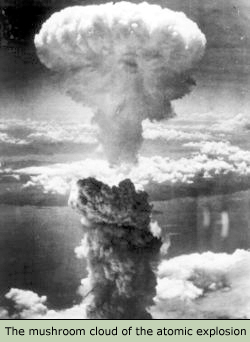
The first atomic bombs were dropped on Hiroshima and Nagasaki in August 1945, killing an estimated 100,000 people. The magnitude of destruction convinced Japan that she could not possibly hope to stand against America, and this led to her decision to surrender on August 15 1945. The Instrument of Surrender of Japan was signed by Japan and the Allied nations on U.S.S Missouri in Tokyo Bay on September 2 1945. This brought about the end to the Pacific War and the Second World War.
The British returned to Singapore and the surrender ceremony at the Municipal Building on 12 September 1945 marked the end of the Japanese Occupation of Singapore. After three years and seven months of hardship under Japanese rule, Singaporeans finally regained their freedom.
next: Statues
|