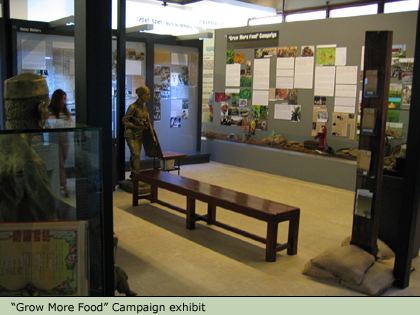
Exhibits 16 - 18 16. "Grow more food" campaign Tapioca became common as tapioca plants were easy to grow and hardy. Land usage for growing food was maximised as narrow strips of land by roads and school fields and gardens in homes were turned into vegetable plots and groves of tapioca plants. Vegetables such as kangkong and long beans were abundant as anyone who had land could grow them easily. People attempted to rear poultry and pigs to provide meat for their diet, but these attempts were hampered by the food shortage. It was hard to feed the animals as food was scarce. Substitutions became more common as the food shortages became more severe. For example, rubber seeds were used as pig feed, and palm oil was used for cooking when cooking oil was in short supply or unavailable. The palm oil left a red colour with the cooked food, but at least the food was cooked and edible. People also countered shortage of flour by using tapioca and potato flour instead. As food was scarce, new sources of food like coconut shoots were found. This exhibited the people's ability to adapt creatively and quickly to the food shortages, allowing them to survive and sustain themselves better.
17. Going back to school During the occupation, education focused on the teaching of Japanese language and culture so as to prepare students for work in a Japanese environment. Primary schools were reoped in April 1942 but Secondary schools were never reopened. Instead, secondary school students had to work. The students who were unemployed were sent to do forced labour. Parents with the means to keep their teenage children out of work resorted to home schooling to educate their child. The teaching of the Japanese language was made compulsory in July 1942. By the end of 1943, all subjects in school had to be taught in Japanese. Students also had to sing the Japanese national anthem and other patriotic songs, celebrate Japanese festivals and learn the art of bowing.
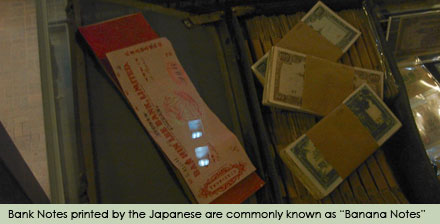
The new Japanese notes issued after the Japanese took Singapore bore equal value to the Straits dollar. They were popularly known as banana notes as the $10 note featured a banana plant. At the end of the occupation, the stockpile of notes in Syonan had a face value of 1200 million dollars. "Banana money" came to mean worthless money. Taxes were levied on re-registering businesses, vehicles and bicycles in order to raise money for the administration. Operating a business without a license can result in severe punishment. Property owners also had to pay property tax to the Japanese unless the property was occupied by the Japanese military. |